Earthworks vs Civil Construction: What’s the Difference?
Earthworks vs Civil Construction: What’s the Difference?
When we talk about large scale construction and infrastructure development, there are two words that come up time and again: earthworks and civil construction. To those who are inexperienced, these may seem similar to them as they both include heavy machinery and substantial budget along with significant ground disturbance. But they infact two different things with varying scopes and methods. Getting to know the difference between the two is important for project owners, engineers and contractors who want to strategize efficiently, manage costs and deliver successful results.
This article will discuss what earthworks and civil construction include respectively, where they differ and overlap and why getting clarity on both before a project starts is important.
What Are Earthworks?
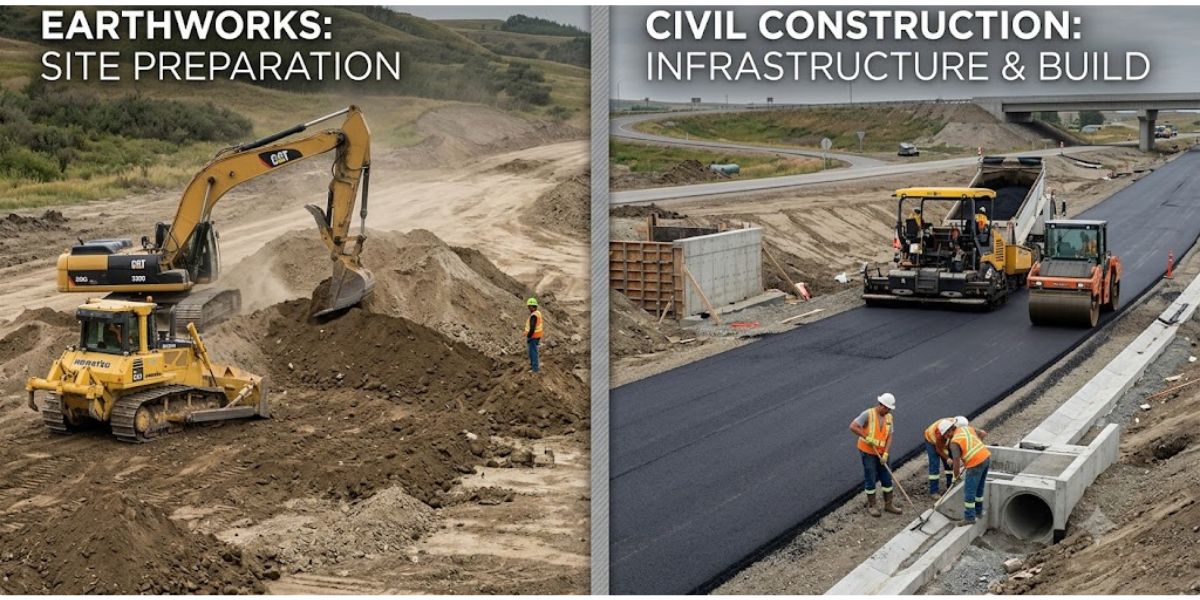
Earthworks refers to the process of moving, shaping, and stabilising large volumes of soil, rock, and other earth materials to prepare a site for construction. It is typically the first major phase of any significant infrastructure or development project and focuses almost entirely on the land itself before any permanent structures are built.
Common earthworks activities include:
- Bulk excavation: Removing large quantities of earth to create foundations, basements, or subgrades
- Cut and fill: Cutting material from higher areas and using it to fill lower areas to create a level platform
- Grading and levelling: Shaping the ground surface to achieve correct slopes and drainage
- Embankment construction: Building raised earth platforms for roads, railways, or dams
- Trenching: Digging narrow channels for pipes, cables, and drainage systems
- Compaction: Mechanically densifying soil layers to achieve the required load-bearing capacity
- Land clearing and stripping: Removing vegetation, topsoil, and debris from a site prior to earthmoving
Earthworks is fundamentally about preparing the ground. The work is measured in cubic metres moved, and success is judged by how accurately the finished surface matches the engineering design, in terms of levels, gradients, compaction specifications, and drainage.
Earthworks projects are typically carried out using heavy plant machinery, including excavators, bulldozers, graders, scrapers, compactors, and dump trucks. The scale can range from a small residential site cut to a multi-million-tonne bulk earthmoving campaign on a mine site, highway project, or dam.
What Is Civil Construction?
Civil construction is a broader discipline that encompasses the design, building, and installation of physical infrastructure that supports communities, industries, and economies. While earthworks is a key component of civil construction, civil construction extends well beyond moving dirt: it includes building the permanent structures and systems that sit on top of (or within) that prepared ground.
Civil construction projects and activities include:
- Roads and highways: Subbase preparation, pavement design, kerbing, line marking, and signage
- Bridges and culverts: Structural concrete and steel works spanning watercourses and roads
- Stormwater and drainage systems: Pipes, pits, channels, retention basins, and outfall structures
- Water and sewer infrastructure: Mains, pump stations, treatment plants, and reticulation networks
- Retaining walls: Concrete, block, or engineered earth structures to manage level changes
- Airfields and ports: Runways, taxiways, hardstands, wharves, and port infrastructure
- Rail infrastructure: Formation, ballast, trackwork, and associated civil structures
Civil construction is governed by engineering standards, local authority regulations, and detailed design documentation. It involves not just moving material but building structures that must perform to defined safety, structural, and service life standards, often for decades or longer.
Key Differences Between Earthworks and Civil Construction
While earthworks and civil construction are closely linked and often performed by the same contractor on the same project, there are clear distinctions in scope, purpose, and execution.
| Factor | Earthworks | Civil Construction |
| Primary focus | Moving and shaping earth | Building permanent infrastructure |
| Project phase | Early / preparatory | Mid to late project phases |
| Materials used | Soil, rock, fill | Concrete, steel, pipe, asphalt |
| Key equipment | Excavators, dozers, graders | Concrete formwork, cranes, pavers |
| Output | Prepared formation or platform | Functional structures and systems |
| Measured by | Cubic metres, compaction tests | Structural specs, load capacity |
How Earthworks and Civil Construction Overlap?
On most civil infrastructure projects, earthworks and civil construction do not operate in isolation, they are sequential and interdependent phases of the same delivery programme. Earthworks must be completed to the correct tolerances before civil construction can commence. A poorly executed bulk earthworks campaign, whether due to insufficient compaction, incorrect levels, or unexpected ground conditions, can cascade into costly delays and remediation during the civil construction phase.
In practice, many civil construction contractors carry out both disciplines. On a road project, for example, the same contractor may handle clearing and grubbing, bulk excavation and fill, subbase compaction, pavement construction, drainage installation, and line marking, all of which span both the earthworks and civil construction categories.
The overlap also extends to documentation. Geotechnical reports, survey data, and compaction test results generated during earthworks directly inform the design and construction of civil structures. Engineers rely on earthworks data to confirm bearing capacity assumptions, drainage behaviour, and subgrade stability before specifying civil works.
Why the Distinction Matters for Project Planning?
Understanding the boundary between earthworks and civil construction is not just academic: it has real, practical implications for how projects are scoped, tendered, contracted, and managed.
Tendering and Procurement
Some contractors specialise exclusively in earthworks and do not carry the skills, plant, or licences for civil construction works. Others operate across both. Defining the scope clearly in tender documentation ensures you attract the right contractors, receive accurate pricing, and avoid ambiguity over responsibility at the interface between the two disciplines.
Programming and Sequencing
Earthworks almost always precedes civil construction, but the handover point is critical. Insufficient lead time on earthworks can compress the civil construction programme, driving up costs. Conversely, earthworks that sit complete and unprotected for extended periods may require rework due to weather, erosion, or trafficking damage.
Risk and Variations
Subsurface conditions, unexpected rock, contaminated soil, high groundwater, typically manifest during earthworks and have knock-on implications for civil construction. Projects with a clear distinction between these scopes find it far easier to attribute variations, manage risk, and price change events fairly for all parties.
In short: earthworks prepares the ground. Civil construction builds on it. Both must be done right for a project to succeed.
Frequently Asked Questions: Earthworks vs Civil Construction
Is earthworks a subset of civil construction?
Yes. Earthworks is generally considered a component of civil construction, specifically the ground-preparation phase that precedes structural and infrastructure works.
Can one contractor handle both earthworks and civil construction?
Yes. Many civil contractors carry both capabilities. However, some specialise in earthworks only, so always confirm scope coverage before awarding contracts.
What machinery is typically used in earthworks?
Common earthworks plant includes excavators, bulldozers, motor graders, vibratory compactors, scrapers, and articulated dump trucks depending on site scale.
What does ‘cut and fill’ mean in earthworks?
Cut and fill means excavating material from high areas and using it to raise low areas, creating a balanced, level platform with minimal material cartage off-site.
Why is soil compaction so important in earthworks?
Proper compaction ensures fill material can support loads without settling. Inadequate compaction causes structural failure, cracking, and costly remediation in later civil works.
What types of projects require both earthworks and civil construction?
Most major projects require both, including roads, subdivisions, industrial estates, mining infrastructure, airports, railways, and large-scale commercial developments.
How are earthworks quantities calculated?
Quantities are calculated in cubic metres using survey data, design levels, and software tools that model cut volumes, fill volumes, and material bulking factors.
What happens if earthworks are not completed correctly?
Poor earthworks leads to structural failures, drainage issues, pavement cracking, and costly remediation, jeopardising the entire civil construction programme above it.
Are retaining walls considered earthworks or civil construction?
Retaining walls are civil construction. They are engineered permanent structures, though their design is informed directly by earthworks and geotechnical conditions.
How do unexpected ground conditions affect a project?
They can trigger costly variations, programme delays, and redesign, impacting both earthworks and downstream civil construction works. Early geotechnical investigation minimises this risk.
Final Thoughts
Earthworks and civil construction are complementary disciplines that together deliver the infrastructure our communities depend on. Earthworks shapes and prepares the ground; civil construction builds the permanent structures that make a project functional, safe, and durable. Neither can succeed without the other, and the interface between them demands careful planning, clear contractual scope, and close coordination between project teams.
Whether you are scoping a new subdivision, planning a road project, or developing an industrial site, understanding the distinction between earthworks and civil construction will help you ask the right questions, engage the right contractors, and set your project up for success from the first cut to the last coat of asphalt.
Related Articles
Bulk Earthworks vs General Earthworks: What’s the Difference?
Earthworks form the base of almost every construction project whether it is…

How Much Does a Driveway Cost to Build in Perth?
Constructing a new driveway in Perth can drastically change the appearance and…
How to Prepare the Ground for a Horse Arena
A well developed horse arena begins from under the surface. Before implementing…