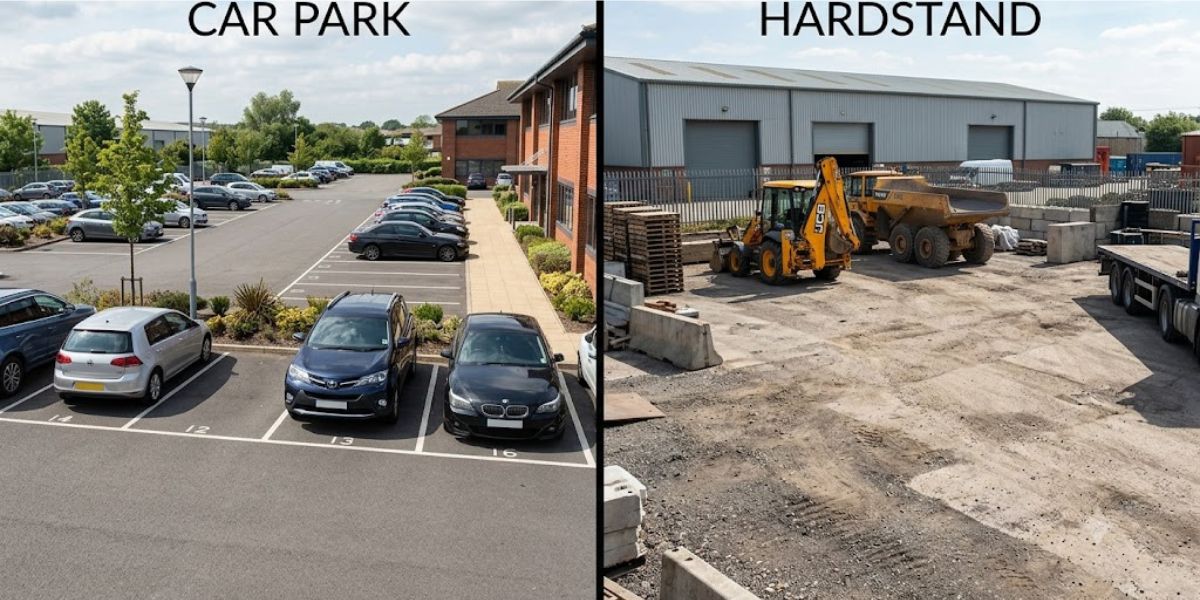
Car Park vs Hardstand: What’s the Difference
Car Park vs Hardstand: What’s the Difference
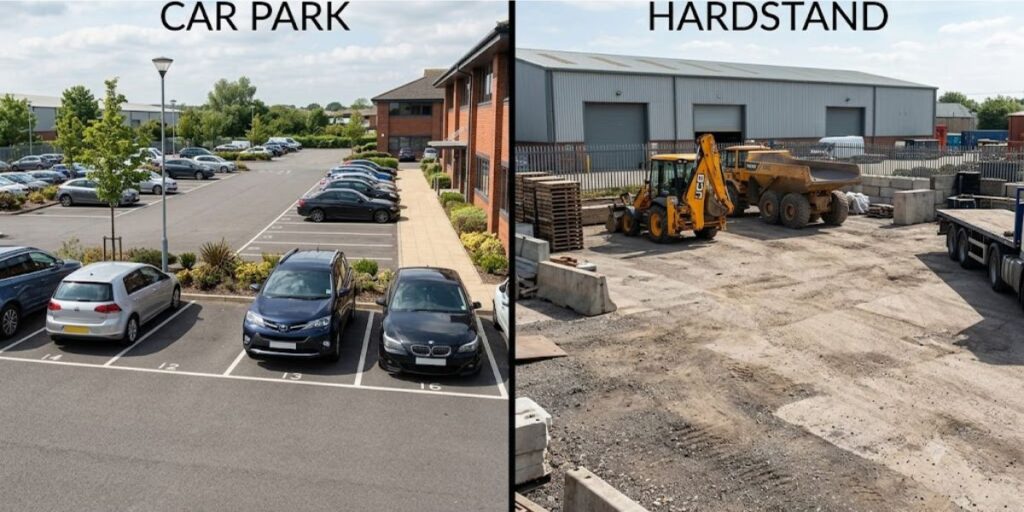
When thinking to plan a residential or industrial development project, selecting the right type of paved surface is essential for functionality and durability along with the cost. Two terms that are usually used interchangeably are car park and hardstand. While both offer a strong and stable surface for vehicles and other activities, they are developed for different purposes.
Getting to know the difference between a car park and a hardstand can help property owners and builders along with developers and businesses select the right solution for their site.
What Is a Car Park?
A car park is a purposely developed area built mainly for parking vehicles. It can be found at residential properties and other commercial locations.
Car parks are usually built around the movement for parking and safe access of passenger vehicles. Based on the location and expected traffic, a car park may involve:
- Clearly marked parking bays
- Vehicle access lanes
- Entry and exit points
- Kerbs and drainage systems
- Pedestrian walkways
- Accessible parking spaces
- Line marking and signage
- Lighting and safety features
The construction method depends on factors such as soil conditions, expected traffic loads, drainage requirements and the type of surface selected.
A residential car park may only need to accommodate cars and light vehicles, while a commercial car park may need to handle a much higher volume of traffic.
What Is a Hardstand?
A hardstand is a deliberately constructed, durable surface designed to support vehicles, equipment, materials or other heavy loads. Unlike a conventional car park, a hardstand is not necessarily intended specifically for parking.
Hardstands are commonly used around warehouses, factories, construction sites, farms, logistics facilities and commercial properties. They may be used for:
- Heavy vehicle access
- Loading and unloading
- Storage of equipment
- Machinery operation
- Container placement
- Material storage
- Vehicle turning areas
- Construction activities
- Outdoor work areas
Hardstands are usually engineered according to the loads and activities they need to accommodate. This means the pavement structure can be significantly stronger than that of a standard parking area where only passenger vehicles are expected.
Car Park vs Hardstand: The Main Difference
The biggest difference between a car park and a hardstand is their intended use and design requirements.
A car park is primarily designed for vehicles to park safely and move efficiently through the site. A hardstand is designed to provide a robust, stable surface capable of supporting specific loads or activities.
For example, a supermarket parking area is a car park because its primary purpose is vehicle parking. A concrete or asphalt area behind a warehouse where trucks load goods, containers are stored and forklifts operate would generally be considered a hardstand.
However, the two can overlap. A commercial property may have a car park for staff and visitors alongside a hardstand for deliveries and heavy vehicles.
Differences in Construction
The construction requirements for car parks and hardstands can vary considerably.
Car Park Construction
A car park is generally constructed with layers that provide adequate support for expected vehicle traffic. These may include:
- Prepared subgrade
- Sub-base material
- Base course
- Asphalt, concrete or another suitable surface
- Line marking and finishing
The pavement thickness and materials depend on factors such as traffic volume, ground conditions and vehicle types.
Hardstand Construction
Hardstands may require a more substantial pavement structure because they can be exposed to higher loads and repeated heavy traffic.
For example, a hardstand used by trucks may require:
- Greater pavement thickness
- Stronger subgrade preparation
- Higher-quality base materials
- Reinforced concrete in some applications
- Enhanced drainage
- Greater resistance to rutting and deformation
The appropriate design should be determined according to the expected loads and site conditions rather than simply selecting the thickest possible pavement.
Surface Materials
Both car parks and hardstands can use different surface materials.
Asphalt
Asphalt is widely used for car parks because it provides a relatively smooth, durable and practical driving surface. It can also be repaired or resurfaced when required.
Concrete
Concrete is often selected where high strength and durability are required. It can be particularly useful for heavy-duty hardstand areas, loading zones and industrial applications.
Gravel or Unsealed Surfaces
Some hardstands, particularly temporary or lower-cost areas, may use compacted gravel or other unsealed materials. The suitability of this approach depends on the intended use, drainage and local requirements.
The correct surface should be selected based on expected traffic, load, environmental conditions, maintenance requirements and budget.
Drainage Requirements
Drainage is an important consideration for both car parks and hardstands.
Water that remains on a paved surface can contribute to deterioration, surface damage and safety problems. Proper falls, drainage channels, pits and other drainage measures may therefore be incorporated into the design.
Hardstands can have particularly important drainage requirements where they are used for industrial operations, material storage or heavy vehicle movements.
The drainage design should account for the site’s existing conditions, surface area and local stormwater requirements.
Traffic and Load Capacity
Another major difference is the type of traffic each area is expected to accommodate.
A standard car park may primarily experience:
- Cars
- SUVs
- Light commercial vehicles
- Occasional delivery vehicles
A hardstand may need to accommodate:
- Trucks
- Trailers
- Forklifts
- Construction machinery
- Heavy equipment
- Containers
Heavy vehicles place significantly greater stresses on pavement structures. Therefore, a surface designed only for passenger cars may not be suitable for frequent heavy truck movements.
Using an ordinary car park pavement for heavy industrial activity can result in cracking, rutting, potholes and premature failure.
Cost Considerations
The cost of a car park or hardstand depends on several factors, including:
- Site preparation
- Ground conditions
- Excavation requirements
- Pavement thickness
- Surface material
- Drainage
- Area size
- Accessibility
- Traffic loading
- Labour and equipment
- Line marking and finishing
A hardstand can cost more than a basic car park because it may require stronger pavement construction and additional site preparation.
However, the cheapest option is not necessarily the most economical in the long term. Selecting a pavement that cannot withstand the expected traffic can result in expensive repairs and reconstruction.
Which One Does Your Property Need?
The right solution depends on what you intend to do with the area.
A car park is generally appropriate if the primary purpose is to provide organised parking for cars and light vehicles.
A hardstand may be more suitable if the area needs to support heavy vehicles, machinery, loading operations, storage or other demanding activities.
In some projects, you may need both. For example, a warehouse could have a designated car park for employees and visitors and a heavy-duty hardstand for trucks and deliveries.
Before construction, consider the expected vehicle types, frequency of use, load requirements, soil conditions and drainage requirements.
Can a Car Park Be Used as a Hardstand?
Not necessarily.
A car park may look strong enough to accommodate trucks or heavy machinery, but its pavement design may not have been engineered for those loads. Repeated heavy vehicle movements can cause damage much faster than normal passenger-vehicle traffic.
If you plan to change the use of an existing car park into a hardstand, it is advisable to have the pavement and underlying ground conditions assessed. Depending on the existing construction, strengthening or reconstruction may be necessary.
Can a Hardstand Be Used as a Car Park?
Yes, a hardstand can often accommodate parked vehicles, provided it is appropriately designed and meets applicable planning, access, drainage, safety and parking requirements.
In fact, some commercial and industrial properties use sections of their hardstand areas for vehicle parking when those areas are not being used for loading, storage or other activities.
However, simply having a strong surface does not automatically make an area an approved car park. Site-specific regulations and design requirements may still apply.
Why Professional Site Planning Matters?
Choosing between a car park and hardstand should not be based solely on appearance or surface material. The underlying pavement structure is critical to performance.
A professional assessment can help determine:
- Expected traffic loads
- Required pavement thickness
- Suitable construction materials
- Subgrade conditions
- Drainage requirements
- Access requirements
- Maintenance considerations
- Relevant local regulations
Good planning can help reduce premature pavement failure and ensure the finished area is suitable for its intended purpose.
Final Thoughts
While car parks and hardstands can look similar, they serve different primary purposes. A car park is mainly designed for organised vehicle parking and everyday vehicle circulation, whereas a hardstand is designed to provide a durable surface for heavier loads, vehicles, machinery, storage or industrial activities.
The best option depends on how the area will actually be used. If the site will primarily accommodate passenger vehicles, a properly designed car park may be sufficient. If heavy vehicles, loading operations, machinery or storage are involved, a purpose-designed hardstand may be the better choice.
Before starting construction, consider the expected loads, ground conditions, drainage, surface material and applicable requirements. Investing in the correct pavement design from the beginning can improve durability, reduce maintenance and deliver better long-term value.
Frequently Asked Questions
1. What is the main difference between a car park and a hardstand?
A car park is primarily designed for parking and movement of vehicles, while a hardstand is designed to support heavier loads, vehicles, machinery, storage or industrial activities.
2. Is a hardstand stronger than a car park?
Not automatically. However, a hardstand intended for heavy-duty use is typically engineered with a pavement structure capable of supporting greater loads than a standard car park.
3. Can trucks use a car park?
Trucks can use a car park if the pavement has been designed for the expected truck loads and the use complies with applicable site and local requirements. A standard car park should not automatically be assumed to be suitable for heavy vehicles.
4. What materials are used for hardstands?
Hardstands can be constructed using concrete, asphalt, compacted gravel and other suitable pavement systems. The choice depends on expected loads, ground conditions, drainage, use and budget.
5. Is asphalt suitable for a hardstand?
Asphalt can be suitable for certain hardstand applications, but its design must account for the expected vehicle loads and traffic frequency. Heavy-duty applications may require a specifically engineered asphalt pavement or an alternative surface such as reinforced concrete.
6. Is concrete better than asphalt for a hardstand?
Neither material is universally better. Concrete can be advantageous for very heavy loads and areas exposed to concentrated stresses, while asphalt can provide a practical and flexible solution for many applications. The right choice depends on the project requirements.
7. Can I turn an existing car park into a hardstand?
Possibly. The existing pavement, subgrade, drainage and construction must be assessed to determine whether it can handle the proposed use. Strengthening or reconstruction may be required.
8. Does a hardstand need drainage?
Yes, drainage should be considered for most hardstand projects. Proper drainage helps prevent water accumulation and can protect the pavement and surrounding property from water-related damage.
Related Articles
Bulk Earthworks vs General Earthworks: What’s the Difference?
Earthworks form the base of almost every construction project whether it is…
How Much Does a Driveway Cost to Build in Perth?
Constructing a new driveway in Perth can drastically change the appearance and…
How to Prepare the Ground for a Horse Arena
A well developed horse arena begins from under the surface. Before implementing…